 Lobsterprotocol
 impermanent loss management suits liquidity strategies with delegated range decisions
Updated onLobsterprotocol impermanent loss management suits liquidity provision when the goal includes delegating adjustments to changing token balances. Its documented dHEDGE-based vault strategy combines Uniswap v3 liquidity with Aave v3 lending around one deposited asset. Range management aims to reduce underperformance against holding, while borrowing manages exposure to the second pool token. Those controls require accepting lending dependencies and a changing liquidity position.
The choice starts with the return being measured and the work being delegated. A vault pursues liquidity income through active management. Direct pool ownership retains the range decisions and their maintenance burden, while holding tokens preserves the original quantities.
A longer holding period creates opportunities for liquidity fees only while the position remains active and trading occurs within its range.
Exposure targets and the right holding benchmark
Impermanent loss compares a liquidity position with holding its original token quantities, so choosing the benchmark comes before judging the strategy. Pool trades change those quantities as relative prices move. A deposit-token vault has a broader objective: increasing value relative to holding the deposited token. These comparisons answer different questions. The first isolates liquidity provision; the second measures the combined strategy after accounting for its assets, debt and costs.
In the documented model, part of the deposited token supplies collateral for borrowing the second pool token. That borrowed token then helps form the liquidity position. Matching an asset exposure with debt in the same token can offset its price movement. The offset changes when trading or interest alters the quantities. This can fit a goal of seeking liquidity income without deliberately adding an equivalent unhedged holding of the second token. The strategy does not remain perfectly neutral at every moment.
Active ranges for recurring swap-fee income
Uniswap v3 concentrates liquidity inside chosen price boundaries, making range selection part of the ongoing work behind swap-fee income. A Uniswap v3 position stops earning swap fees while the pool price lies outside its selected range.
An automated vault delegates those boundary adjustments to its algorithm. This suits a strategy requiring ongoing range management through changing relative prices. The algorithm determines the adjustments within the vault's permitted operations. Evaluating the managed position includes the costs incurred while making those changes.
Concentrating capital can increase fee income for the same committed capital when trading occurs inside the chosen interval. A narrow position can become inactive after a modest relative-price move.
Rebalancing changes the position exposed to subsequent price movements. It can restore an active range, with a different token mix and additional execution costs. Raising adjustment frequency also raises blockchain and trading costs. More frequent activity needs an economic benefit, such as additional fees or better exposure control.
A holding-only allocation avoids liquidity-pool reallocation. It is the closer match when preserving token quantities matters more than pursuing swap-fee income.
Manual range management for direct control
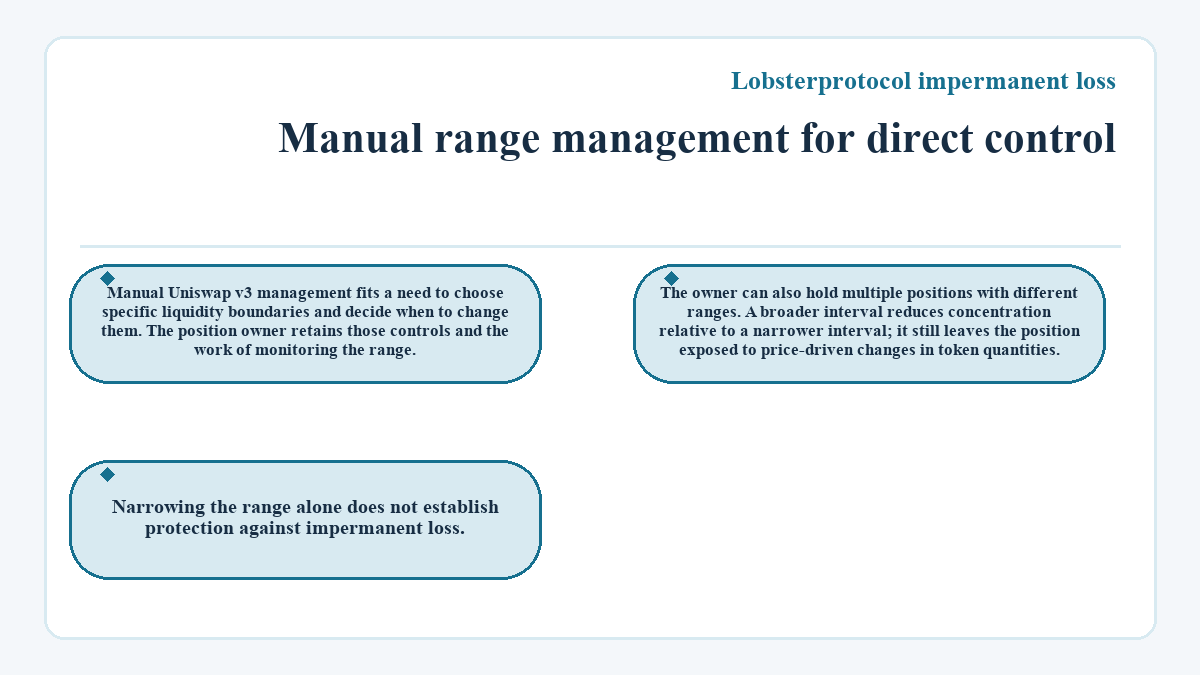
Manual Uniswap v3 management fits a need to choose specific liquidity boundaries and decide when to change them. The position owner retains those controls and the work of monitoring the range. The owner can also hold multiple positions with different ranges. A broader interval reduces concentration relative to a narrower interval; it still leaves the position exposed to price-driven changes in token quantities. Narrowing the range alone does not establish protection against impermanent loss.
A fee-earning position with a remaining shortfall
Fee income can coexist with impermanent loss because earning fees and matching the holding benchmark are separate measures of performance. Consider a hypothetical Uniswap v3 comparison at one valuation time. Every amount uses the same deposit-token unit. Holding the original pool-token quantities separately would be worth 1,263 units. The liquidity position is worth 1,238 units before fees, with another 13 units of accrued liquidity provider fees.
The shortfall before fees is
1,263 - 1,238 = 25
units. Adding fee income produces
1,238 + 13 = 1,251
units. The position still trails holding by
1,263 - 1,251 = 12
units. Fees offset part of the shortfall in this case; positive fee income has not erased it.
Whole-vault suitability requires accounting for collateral, debt and the remaining costs. This isolated position excludes those components. It also assumes no changes by the position owner during the comparison period. Different prices or fees change the shortfall; range resets require tracking the resulting token quantities.
Borrowing constraints and the limits of withdrawal control
Borrowing creates a failure boundary beyond the liquidity range, so strategy suitability includes collateral management as well as fee generation. Leaving a Uniswap range does not itself liquidate that liquidity position. The borrowing leg has a separate collateral threshold. An Aave borrowing position becomes eligible for liquidation when its health factor falls below 1. A supply-only lending allocation avoids creating that borrowing position, although it has its own lending and contract exposures.
Withdrawal control concerns who can request an exit from the vault. The documented dHEDGE-based model gives the depositor that authority and limits the algorithm to permitted strategy operations. Those permissions do not restore value lost through liquidity provision or a liquidation. A requirement to stop future exposure differs from a requirement to recover the original balance. Holding tokens outside a vault avoids depending on its withdrawal mechanism; detailed exit conditions remain specific to the chosen vault.
Holding time and recurring strategy costs
Time creates additional opportunities for fee income only while liquidity is active and trading occurs in its range. A longer holding period also extends exposure to changing prices and borrowing costs. No fixed waiting period ensures recovery of a holding shortfall. The decision remains whether the net strategy serves the desired exposure for that period. Management charges follow managed value and can continue during a loss-making period. The documented vault fee schedule quotes an annual management charge of 3% on total value locked.
Everyday questions about Lobsterprotocol impermanent loss
Can a Lobsterprotocol liquidity position gain value and still have impermanent loss?
Yes, a liquidity position can gain value while the original tokens would have gained more outside the pool. Impermanent loss describes that relative shortfall. Comparing the position only with its starting value misses this distinction, especially when the deposited asset also changes in price.
Is a full-range loss formula enough for a concentrated Uniswap v3 position?
A full-range formula does not capture every concentrated position because the chosen price boundaries affect its token balances. A calculation must reflect the actual interval and entry quantities. When the algorithm changes ranges, a single calculation from the starting price ratio cannot describe the complete managed history.
Does underlying-protocol insurance cover impermanent loss automatically?
Impermanent-loss reimbursement requires insurance terms covering that loss and its circumstances. Cover for a failure in an underlying smart contract addresses a different event from price-driven pool underperformance. A policy covering dHEDGE or Uniswap v3 contract risks does not thereby promise compensation for ordinary changes in pool-token values.
Are backtested range adjustments proof of returns on a particular deposit?
Backtested range adjustments describe simulated strategy decisions, so they do not establish the return on a particular deposit. A simulation uses its own price history and trading assumptions. The result of an actual allocation also reflects its entry time, executed adjustments, accrued fees and borrowing costs.
Would a return to the starting price ratio erase every vault loss?
Returning to the starting token-price ratio does not necessarily restore an actively managed vault's earlier value. Range changes and trades can alter the quantities held along the way. Borrowing interest, management charges and execution costs also affect the balance, even when the eventual price ratio matches its starting level.
Do closely tracking pool tokens remove the need for impermanent-loss management?
Pool tokens whose prices closely track each other can have smaller relative-price changes, but they do not make a chosen liquidity range immune to divergence. The actual price ratio can still change or leave that interval. Concentrating liquidity around an expected relationship therefore retains a dependency on how that relationship behaves.