 Lobsterprotocol
 automates strategy management for a fee on vault value
Updated onLobsterprotocol charges for automated lending and liquidity management through its documented vault model. Its published schedule quotes 3% annually on vault value, collected in fractions every four hours. Automation is worth considering when the delegated work and net outcome justify that recurring cost. Manual Aave v3 lending may involve fewer moving parts than managing lending alongside Uniswap v3 liquidity. Managing comparable positions yourself retains control over adjustments and carries the work of making them. The comparison turns on the actual strategy, its costs and the performance period, with exit control considered separately from profitability.
Key takeaway: The documented 3% annual charge applies to vault value, so a losing strategy can still incur management fees.
A recurring charge on vault value
The management fee follows the value the vault manages, so evaluating its cost requires the fee base and holding period alongside the quoted annual rate. The documented management rate is 3% per year on total value locked, or TVL. The schedule spreads deductions across four-hour intervals. That basis differs from charging a percentage of investment profits. The charge need not disappear when returns turn negative.
Lobsterprotocol's displayed track records already account for management charges. Deducting the same charge again understates those returns. A comparison using gross figures needs different treatment from one using those net records. Borrowing costs and trading outcomes also affect the strategy's economics; the management rate alone does not describe its total return.
Does automation replace the work your strategy requires?
Automation delegates more work when the task involves coordinating lending and liquidity positions than when it involves maintaining a supply-only lending position. The documented vault strategy combines those underlying services behind a single deposit. A manual equivalent must cover comparable positions before its cost difference becomes meaningful.
Direct Aave v3 lending leaves allocation decisions with the wallet owner. Adding a loan requires debt management; insufficient collateral can lead to liquidation. Direct Uniswap v3 liquidity provision puts range choices and position adjustments with the position owner. The managed model delegates permitted strategy operations to an algorithm. These routes differ in workload and exposure, so a single advertised yield cannot make them equivalent.
Manual management avoids this particular vault-management charge. Both routes can incur borrowing costs, trading fees, slippage and blockchain transaction fees. An automated path must justify its fee against the actual manual plan, including the tasks that plan omits. Time saved measures a convenience benefit; after-fee performance measures an investment outcome.
Live rates and liquidity ranges
Aave borrowing rates and Uniswap v3 fee income change with market conditions, so the management rate cannot forecast total returns. Aave adjusts borrowing rates as utilization and governance parameters change. A loan's cost therefore moves independently of a quoted annual management rate.
Uniswap v3 fee income depends on a position's active range. A Uniswap v3 position stops earning swap fees when the market price leaves its chosen range. If the price re-enters that interval, its liquidity becomes active and earns fees again. Changing a range alters where capital participates in trading. Trading-fee income can fall short of impermanent loss. Any borrowed position also carries debt interest. A pool's swap-fee tier therefore cannot substitute for the vault's net performance.
A paper comparison before committing funds
In this hypothetical comparison, a reader wants to price delegation before depositing, keeping the choice reversible while considering vault management and direct management. Assume a constant fee base of 8,472 accounting units for one year, with no deposits or withdrawals. The reader first calculates the annual charge on paper, using the documented 3% rate. This leaves the existing asset position unchanged while putting a value on the management service.
The constant-base calculation is
8,472 * 0.03 = 254.16
, giving an annual fee estimate of 254.16 accounting units. This estimate holds the fee base fixed. Actual four-hour deductions and market changes can alter that base, so it does not reconstruct a vault's realized charge. A larger fee base increases the estimate proportionally, while a lower base reduces it.
With all other costs equal, the managed strategy's extra gross gain over direct management would need to cover that amount. When comparing Lobsterprotocol's already net track record, the reader leaves that deduction in place and compares the manual outcome over the same period. No trading return or exact exit amount follows from this calculation.
Delegated trades and retained withdrawal rights
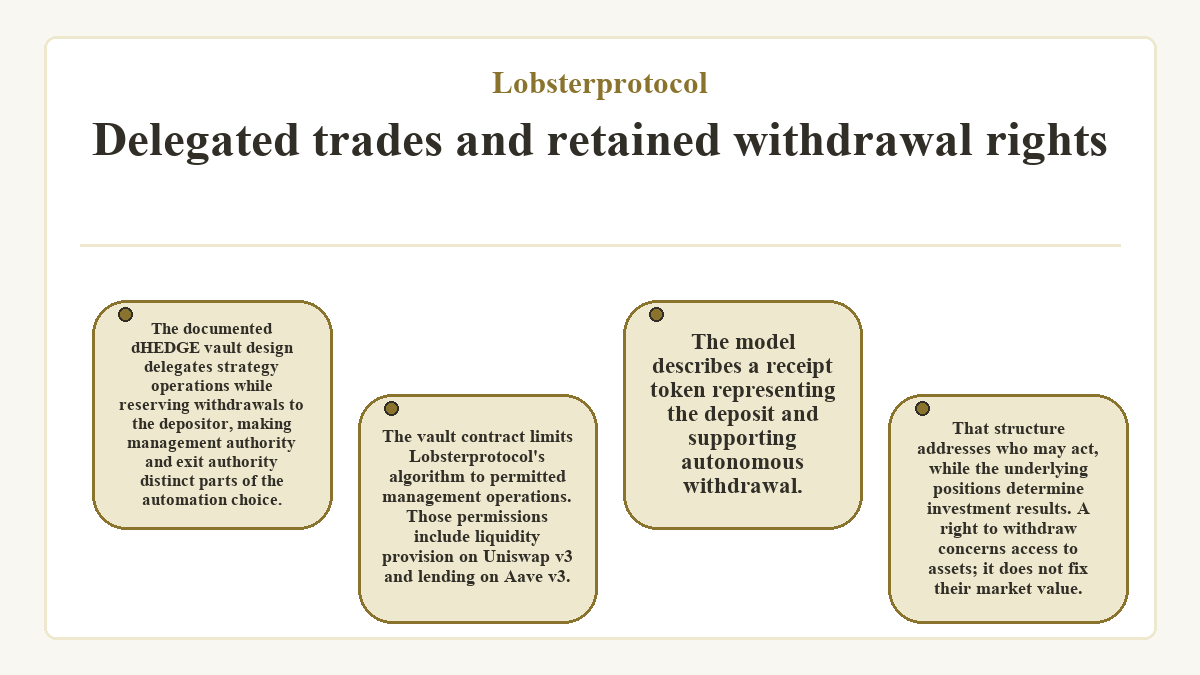
The documented dHEDGE vault design delegates strategy operations while reserving withdrawals to the depositor, making management authority and exit authority distinct parts of the automation choice. The vault contract limits Lobsterprotocol's algorithm to permitted management operations. Those permissions include liquidity provision on Uniswap v3 and lending on Aave v3. The model describes a receipt token representing the deposit and supporting autonomous withdrawal. That structure addresses who may act, while the underlying positions determine investment results. A right to withdraw concerns access to assets; it does not fix their market value.
Net performance and the next choice
A fair performance comparison matches the valuation unit, the exposure and the measurement period before attributing any difference to automation. A deposit token can gain value in money terms even when a strategy fails to outperform holding it. The documented objective is to outperform the deposited asset, so a rise in its market price alone does not show the fee earned its place.
Live vault records and backtests answer different questions. A backtest examines a strategy against historical conditions; a live record reflects execution over its recorded interval. Neither can turn a changing lending rate or future trading volume into a fixed return.
In its AMA recap dated December 9, 2024, Lobsterprotocol acknowledged that product performance needed improvement across market conditions. The team postponed its token generation event while focusing on stronger strategies.
A supply-only alternative changes the exposure; a manual multi-protocol alternative changes who performs ongoing adjustments. Decide which comparison matches your intended strategy before placing a value on delegation.
What readers ask about Lobsterprotocol
Do Uniswap v3 fees compound automatically in a manually managed position?
Uniswap v3 accumulates trading fees as claimable balances tied to each position. The position owner must collect them; they do not automatically increase the position's liquidity. Manually collecting and reinvesting those fees adds management work alongside choosing the liquidity range.
When does borrowing on Aave v3 start adding interest to a manual strategy?
Borrowing on Aave v3 starts accruing interest immediately. The interest applies to the borrowed amount. Variable borrowing rates respond to utilization and governance settings. Supplying assets without taking a loan does not create that borrow-interest bill.
Is the four-hour deduction interval also a trading schedule?
The documented four-hour interval specifies management-fee deductions. It does not establish how often the algorithm changes liquidity positions or adjusts activity across protocols.
Does paying the management fee include insurance against contract losses?
Paying for vault management does not itself establish insurance cover against smart-contract losses. The documented insurance approach involves arranging cover for underlying protocols separately. Any protection depends on the cover actually in force and the event it covers.
Did the December 2024 Lobster Points announcement promise a fee rebate?
The December 9, 2024 announcement described earned Lobster Points counting toward a future airdrop, without specifying a management-fee rebate. It did not assign those points a cash value. That historical promise supplies no numerical offset for the documented vault charge on its own.
How do deposits made on different dates affect the fee comparison?
Deposits made on different dates spend different periods under management. A comparison of fees and returns must therefore account for when each contribution entered the strategy. Comparing only the ending balance with the earliest starting balance can confuse additional deposits with investment returns. The quoted annual management rate does not correct that measurement problem.
Which Uniswap v3 fees count as income when comparing vault returns?
Liquidity providers receive the LP share of a Uniswap v3 swap fee. In pools with protocol fees enabled, part goes to the protocol. The pool's configured split determines what providers retain. The protocol fee is not an additional Lobsterprotocol management payment, and the total swap-fee tier need not equal LP revenue.